
WEBDESK - NAYADAUR
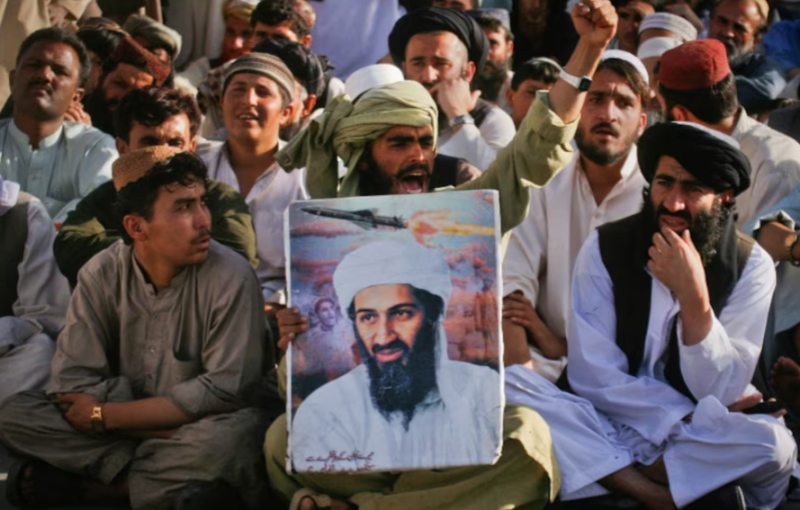
The militant network founded by Osama bin Laden has undergone major changes since the attacks of Sept. 11, 2001, surviving the loss of its founder and several senior leaders while expanding through regional affiliates.
Al Qaeda emerged in the late 1980s under bin Laden, a Saudi-born militant who helped recruit and support Arab volunteers fighting the Soviet Union in Afghanistan. The group developed into a transnational jihadist network opposed to the United States, Israel and allied governments.
Before the Sept. 11 attacks, al Qaeda had already carried out or supported attacks against U.S. interests, including the 1998 bombings of U.S. embassies in Kenya and Tanzania, which killed 224 people.
On Sept. 11, 2001, 19 hijackers seized four passenger aircraft. Two planes were flown into New York's World Trade Center, another struck the Pentagon, while a fourth crashed in Pennsylvania after passengers attempted to regain control. Nearly 3,000 people were killed.
The United States invaded Afghanistan in October 2001, overthrowing the Taliban and forcing al Qaeda from its main base of operations. Bin Laden escaped a U.S.-led pursuit and remained at large until U.S. special forces killed him in Abbottabad, Pakistan, in 2011.
Other senior figures were also eliminated or captured. Khalid Sheikh Mohammed, described as the self-professed mastermind of the Sept. 11 attacks, was captured in Pakistan in 2003. Bin Laden's successor, Ayman al-Zawahri, was killed in a U.S. drone strike in Kabul in 2022.
Seif al-Adel, an Egyptian militant, is now believed to be al Qaeda's de facto leader.
Despite the loss of its central leadership, the organization continued to influence militant movements. Al Qaeda-linked or inspired attacks included the 2002 Bali nightclub bombing, the 2004 Madrid train bombings and the 2005 London transport attacks.
Regional affiliates subsequently emerged in Iraq, North Africa, the Arabian Peninsula and Syria. In Africa, al Qaeda-aligned groups such as al Shabaab in Somalia and Jama'at Nusrat al-Islam wal-Muslimin, or JNIM, in the Sahel became important forces.
The emergence of the Islamic State dealt another major blow to al Qaeda. Abu Bakr al-Baghdadi broke with al Qaeda and declared a caliphate across parts of Syria and Iraq in 2014. The rivalry between the two militant networks continues, particularly in West Africa.
Al Qaeda also suffered the loss of its Syrian affiliate, the Nusra Front, after it broke away in 2016. Its former leader, Ahmed al-Sharaa, later became Syria's president after Bashar al-Assad was toppled in 2024.
Today, Africa remains a major center of al Qaeda-linked activity, particularly Somalia and the Sahel. The Tehrik-e Taliban Pakistan, or TTP, has also expanded its insurgency in northwestern Pakistan and has received ideological guidance, training and support from al Qaeda, according to a recent U.N. report.
Another U.N. report said al Qaeda continued to receive patronage from Afghanistan's de facto authorities and maintained an undiminished appetite for external operations. Kabul denies allowing al Qaeda to operate from Afghan territory.
Experts say al Qaeda is no longer at the height of its power but remains resilient. Rather than relying heavily on prominent leaders, the network increasingly operates through lower-profile figures who are harder to identify and target.
The evolution has allowed al Qaeda to survive 25 years after Sept. 11, transforming from a centrally directed organization into a looser network whose affiliates continue to wield influence in several conflict zones.