
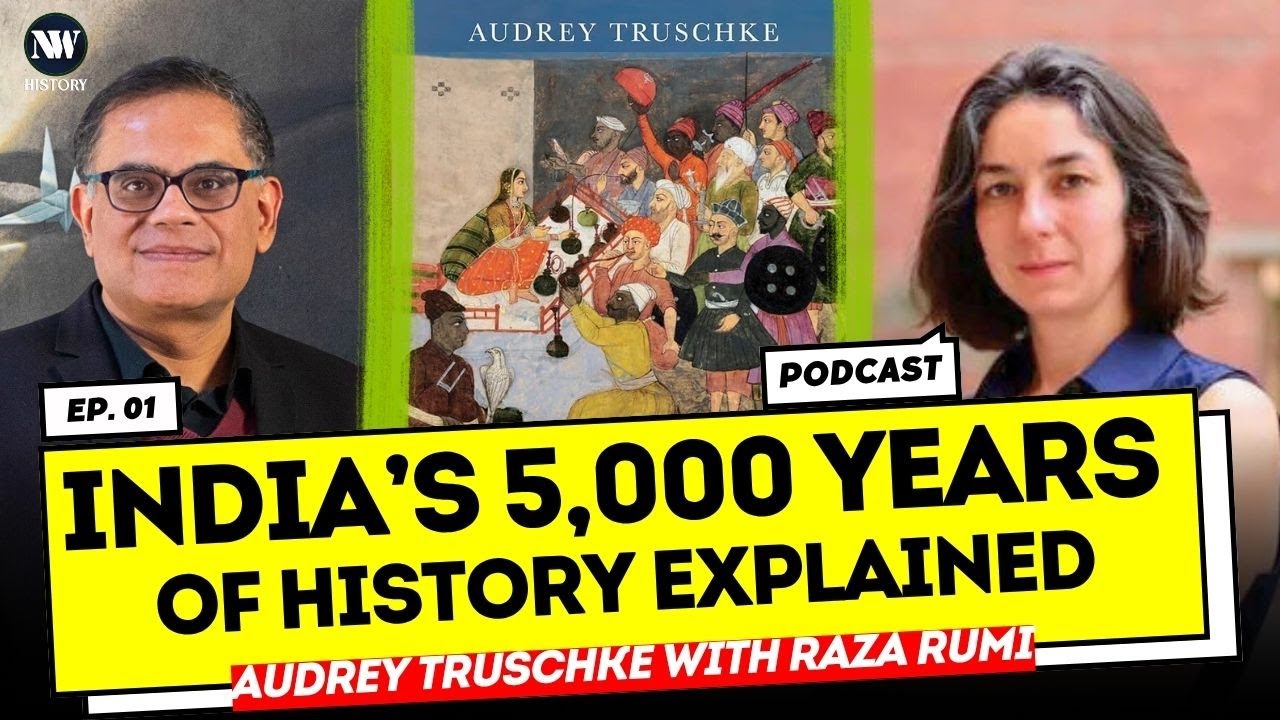
In a recent episode of New Wave History, Professor Audrey Truschke of Rutgers University sat down for an illuminating discussion on her sweeping new book, which chronicles 5,000 years of Indian history. The conversation, led by the host, delved into the book’s scope, challenges, and its striking reimagining of how the subcontinent’s story has been told.
Truschke revealed that the project began at the suggestion of Princeton University Press, a proposal she initially refused, calling it “a patently insane idea” to summarise millennia of history for a quarter of the world’s population in a single volume. Yet, she ultimately took on the challenge, motivated by the need for an accessible overview of South Asian history for students and general readers alike.
The historian made it clear that “India” in her book refers to the pre-Partition subcontinent, encompassing modern India, Pakistan, Bangladesh, and parts of Afghanistan. She stressed that the term historically denoted a vast cultural and geographical region, not merely the modern Republic of India.
Truschke also addressed how modern nationalisms in India and Pakistan share similar mythologies, both seeking an imagined “pure past” uncontaminated by migration or diversity. In contrast, her book foregrounds India’s deep connectivity, where trade, ideas, and people constantly crossed borders.
Discussing ancient civilisations, Truschke highlighted the sophistication of the Indus Valley cities, cautioning against reading modern politics into ancient identities. She firmly dismissed the claim that the Indus civilisation was “Vedic” in origin, calling it “a 100% modern political issue.”
The conversation also touched on Ashoka’s reign, not as a utopia of peace, but as a complex blend of conquest, reform, and moral experimentation. Similarly, she re-evaluated the so-called “Golden Age” of the Guptas, urging audiences to move beyond mythic simplifications.
Through her scholarship, Truschke invites readers to rethink South Asia’s past, not as isolated national stories, but as a shared, interconnected civilisational journey spanning five millennia.