
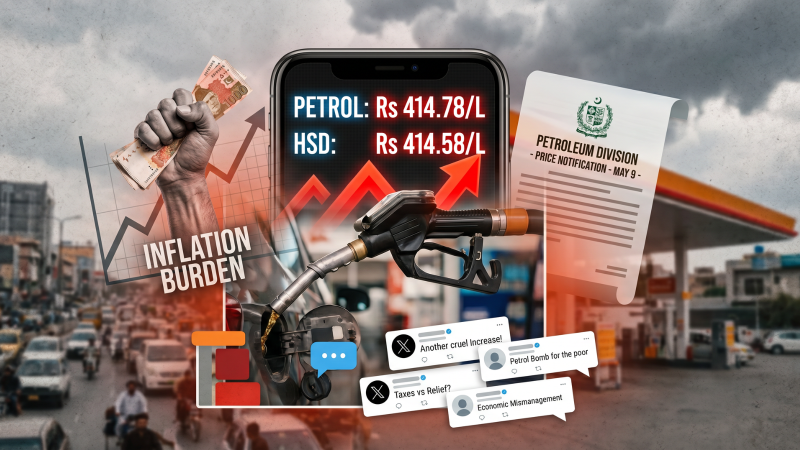
The government has increased petroleum prices once again, raising the cost of petrol by Rs14.92 per litre and high-speed diesel (HSD) by Rs15 per litre, according to an official notification issued by the Petroleum Division on Friday. After the latest adjustment, petrol now stands at Rs414.78 per litre while HSD is priced at Rs414.58 per litre. The new prices are effective from May 9.
The latest revision comes amid a pattern of weekly fuel price adjustments in recent months, following global energy market volatility linked to geopolitical tensions and disruptions in oil supply routes. Since late February, fuel prices in Pakistan have seen sharp swings, including major hikes in March, followed by partial reductions and subsequent increases.
Earlier episodes included a Rs55 per litre jump in March, followed by further sharp adjustments in early April, when officials also announced a targeted subsidy mechanism. Subsequent reductions by the prime minister were followed again by fresh increases, reflecting what officials describe as pass-through adjustments tied to international prices and taxation structure.
However, the latest increase has triggered strong criticism on social media, with activists, journalists, and former officials questioning both the scale of taxation and the government’s economic management.
Political activist Ammar Ali Jan described the hike as “another cruel increase in petrol prices,” arguing that the burden is being shifted onto ordinary citizens while large subsidies continue elsewhere. In a widely circulated comment, he said the state provides “at least Rs2,700 billion annually in subsidies to banks, feudals, military corporations, independent power producers, and real estate elites,” while ordinary households are “forced to sacrifice their families for the luxuries of elites.”
Another cruel hike in petrol prices. Please remember that the govt gives at least Rs. 2700 billion annually in subsidies to banks, feudals, military corporations, IPPs, and real estate elites. Ordinary people are being forced to sacrifice their families for luxuries of elites.
— Ammar Ali Jan (@ammaralijan) May 8, 2026
Finance journalist Shahbaz Rana questioned the logic behind the increase, pointing out that international petroleum prices had actually shown a minor decline. He argued that instead of passing on relief, the government had increased taxes and levies, pushing retail prices higher. “What sort of economic management is this?” he wrote, noting that petroleum levies had risen significantly, exceeding earlier commitments under international financial arrangements, and warning that ordinary consumers were effectively absorbing the cost of fiscal and administrative inefficiencies.
There was a reduction of 21 paisa in petrol price in international market. But the government further increased the tax by Rs17.91 per litre to increase price to Rs415.
— Shahbaz Rana (@81ShahbazRana) May 9, 2026
What sort of economic management is this?
Now Government is charging Rs117.5 per litre levy on petrol. This is…
Former finance minister Miftah Ismail also criticised the pricing structure, saying the increase was driven entirely by higher taxes and levies rather than global oil prices. He noted that a significant portion of the retail price now goes directly to the government through various charges, arguing that the state has increased its revenue burden on fuel rather than absorbing shocks or providing relief.
Petrol and diesel prices have been increased by the Noon government by Rs 15 per litre each to Rs 415 per litre. The entire increase in both has been due to increase in levy and taxes. Not due to any increase in prices.
— Miftah Ismail (@MiftahIsmail) May 9, 2026
For petrol now we pay levy of Rs 120 per litre and for… pic.twitter.com/K465mf1OYj
Investigative journalist Zahid Gishkori called for an immediate rollback of the decision, saying the price hike had landed like a “petrol bomb” on middle- and lower-income groups. He urged the prime minister to reconsider the move, warning of further strain on already stressed households.
وزیراعظم شہباز شریف کو آج پیٹرولیم مصنوعات کی قیمتوں میں کیے گئے اضافے کو فوری واپس لینا چاہیے۔ پیٹرولیم مصنوعات کی یہ بلاجواز قیمتوں میں بڑھوتری متوسط، اعلیٰ متوسط طبقے اور غریب عوام پر پیٹرول بم بن کر گری ہے۔ براہِ کرم غریب عوام کے بارے میں سوچیں، وزیرِاعظم صاحب۔⁰#پیٹرول_بم…
— Zahid Gishkori (@ZahidGishkori) May 8, 2026
Former Minister Khawaja Saad Rafique said the petrol and diesel price hike has intensified public suffering, asking how ordinary people can survive rising inflation. He argued Pakistan should focus on stopping tax evasion and broadening the tax base instead of increasing levies and fuel taxes.
The increase in petrol and diesel prices has brought out the cries of the people.
— Khawaja Saad Rafique (@KhSaad_Rafique) May 8, 2026
How will people survive????
The Zionist-American war imposed on Iran has become the basis for economic decline, increased poverty and back-breaking inflation for the entire region.
Instead of…