
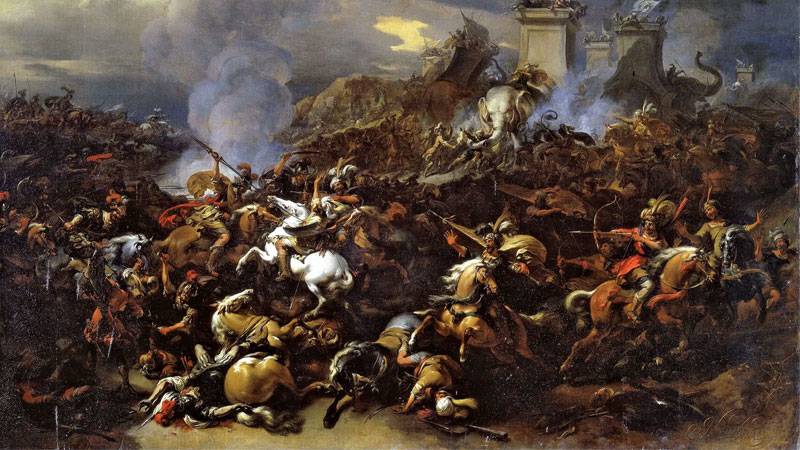
In 326 BCE, on the banks of the River Hydaspes, modern-day Jhelum in Pakistan, unfolded one of antiquity’s most remarkable confrontations. Here, Alexander the Great, still in his twenties yet already master of the Persian Empire, faced King Porus of the Paurava kingdom. More than a clash of armies, the battle represented a meeting of two civilisations, two traditions of warfare, and two visions of kingship.
Though victorious, Alexander would never march further east. The Hydaspes thus marked both the zenith of his conquests and the moment when his empire met its natural limits. Analysing the battle offers insight not only into military strategy but also into the cultural dynamics of the Hellenistic age.
After his decisive victories at Issus and Gaugamela, Alexander pressed further east. By 327 BCE, he had crossed the Hindu Kush into the north-western frontiers of the Indian subcontinent. Local tribes in Swat and Gandhara were subdued with characteristic ruthlessness, yet Porus posed a new and serious challenge.
Ruling between the Jhelum and Chenab rivers, Porus commanded territory that was both strategically vital and fiercely loyal. Unlike many local chiefs who submitted without resistance, Porus chose to defend his kingdom. For Alexander, who thrived on difficult challenges, defeating Porus promised not just another conquest, but glory on a scale even greater than his Persian victories.
Porus marshalled an army that alarmed even Alexander’s veterans. Ancient sources speak of 30,000 infantry, 4,000 cavalry, and some 200 war elephants, the latter a terrifying innovation for Macedonians who had never faced them in such numbers.
Stationed on the eastern bank of the Hydaspes, Porus used the river itself as his first line of defence. Swollen by monsoon rains, its currents made a frontal crossing nearly suicidal. Behind this watery barrier, the elephants loomed as a living wall of iron and ivory.
This deployment reflected Porus’s deep understanding of terrain and psychology. The river delayed Alexander’s attack, while the elephants were intended to shatter the morale of any who dared cross.
Alexander, though bold, was no fool. His force of roughly 40,000 infantry and 5,000 cavalry could not risk a direct assault. To wade through the river under arrow-fire and elephant charge would have been a death sentence.
Instead, he resorted to deception, his trademark stratagem. For days, he feigned preparations for a frontal crossing, marching up and down the western bank, making campfires, and keeping Porus’s scouts guessing. At night, his men created deliberate noise to sow confusion. Meanwhile, Alexander scouted upstream for a weaker point.
Eventually, some 27 kilometres north, he found a wooded island suitable for a secret crossing. This discovery would alter the course of the campaign.
On a stormy night, masked by thunder and rain, Alexander led a selected force across the river. Using boats, rafts, and improvised floats of animal hide, his cavalry and light infantry braved the swollen waters. By dawn, they had established a precarious foothold on the far bank.
Porus, alerted by scouts, dispatched his cavalry and chariots to intercept. Yet the muddy ground neutralised his chariots, leaving them vulnerable. Alexander’s cavalry quickly routed them, buying time for his full army to cross. The stage was set for one of the most brutal battles of antiquity.
Porus now deployed his forces in full. The elephants formed the centre, infantry massed between them, with cavalry covering the flanks. Behind stood archers and reserves. It was a formation designed to exploit the elephants’ shock value while maintaining a solid infantry line.
Alexander matched him with equal ingenuity. His Companion Cavalry, under his personal command, held the right flank. The Macedonian phalanx advanced steadily at the centre, sarissas (pikes) levelled. On the left, cavalry and horse archers prepared to manoeuvre around Porus’s flanks.
The battle opened with Alexander’s cavalry striking Porus’s flanks, while the phalanx pressed towards the elephant line.
The war elephants caused havoc. Charging forward, they trampled Macedonian infantry, broke phalanx formations, and scattered men with tusks and trunks. Archers mounted on their backs added to the carnage.
But Alexander’s soldiers adapted. Targeting the elephants’ eyes and mahouts (drivers), they gradually sowed confusion. Wounded and maddened, the elephants turned on friend and foe alike, trampling Porus’s own men. What began as Porus’s greatest advantage slowly turned into a liability.
Meanwhile, Alexander’s cavalry outnumbered and outmanoeuvred Porus’s horsemen. The muddy terrain favoured the lighter Macedonian cavalry, who encircled Porus’s flanks. Step by step, the Paurava army crumbled.
Despite mounting losses, Porus fought on. Mounted atop his elephant, towering over the battlefield, he continued directing his troops with stoic courage. Ancient chroniclers admired his composure and refusal to surrender.
But the outcome was inevitable. Exhaustion, attrition, and chaos among the elephants broke his army. Surrounded and wounded, Porus was eventually captured alive.
Here the story takes an extraordinary turn. When the defeated Porus was brought before Alexander, the Macedonian asked how he wished to be treated. Porus’s response was simple: “Like a king.”
Impressed by his courage and dignity, Alexander not only spared him but reinstated him as ruler, even granting him additional territory. This gesture was not mere magnanimity; it was political calculation. By honouring Porus, Alexander secured loyalty among local populations and stabilised his eastern frontier.
The Battle of the Hydaspes left multiple legacies, both military and cultural.
Military lessons: It highlighted Alexander’s mastery of deception, river-crossing operations, and adaptability against unfamiliar weapons such as elephants.
Cultural encounter: The clash symbolised the meeting of the Greek and Indian worlds. The subsequent Greco-Buddhist fusion in Gandhara art and thought owed much to the Hellenistic presence that followed.
Limits of conquest: Despite victory, the battle exposed the exhaustion of Alexander’s men. Terrified by the prospect of facing even larger Indian kingdoms beyond the Ganges, they refused to march further east. Hydaspes thus marked the natural frontier of Alexander’s empire.
The Battle of the Hydaspes was not just another victory for Alexander, it was a defining moment in his career. Militarily, it demonstrated his brilliance in strategy and adaptability. Politically, it showed his ability to combine ruthlessness with calculated generosity. Culturally, it opened a channel between East and West that would shape centuries of interaction.
Yet it also marked the boundary of ambition. Alexander, the man who dreamed of conquering the world, was forced to accept the limits of geography, logistics, and human endurance.
More than two millennia later, the Hydaspes still resonates. On the banks of the Jhelum, one can almost hear the thunder of elephants, the clash of sarissas, and the cries of men who fought in one of history’s most legendary encounters.